Friday, August 1, 2014

Penrose Tile Quilt: Christmas Tree Skirt - Construction Phase


The trick with this design is the combination of machine piecing with paper piecing.  Instead of paper piecing each patch, I machine piece the patches that make up each rhombus and paper piece the rhombi.

Here's how I machine pieced the fat rhombi:


This is a good way to make 40 thin rhombi at one time:


Once all the rhombi have been machine pieced, they are ready to be basted onto the paper and hand assembled.


< Previous Post - Design Phase


Saturday, June 7, 2014

Penrose Tile Quilt: Christmas Tree Skirt - Design Phase

I made this Christmas Tree Skirt as a wedding present for my niece and nephew-in-law:


It's based on a Penrose tiling, which is an aperiodic tiling derived from tiling pentagons. (I'll let wikipedia explain it).

I used a combination of machine piecing and  English paper piecing to construct it using two types of diamonds:

and I lay them out in this base tiling:


Then I do two tricky things that exploit some of the niftier properties of Penrose tilings:  matching rules and inflation/deflation.  These need to be explained in more detail...

Constructing Penrose Tiling using Matching Rules


These rhombi (plural of rhombus, a fancy word for diamond) can be tiled in a lot of ways that are not actually Penrose tilings.  They can be tiled in ways that are periodic, or completely non-periodic:


and you can certainly make some lovely quilts doing this:

This was made by Domesticat

This was made by Dorothea
However, these are not strictly Penrose tilings.  To make a quilt that has that quirky stars-with-ripples effect that the aperiodic tiling creates, you need to follow the matching rules:


My first plan was to design a quilt that copied the curved design as shown in the above diagram (but just the pink lines):


NOTE:  Penrose tiling is beyond the powers of Electric Quilt, so I designed these using Geometer's Sketchpad instead.


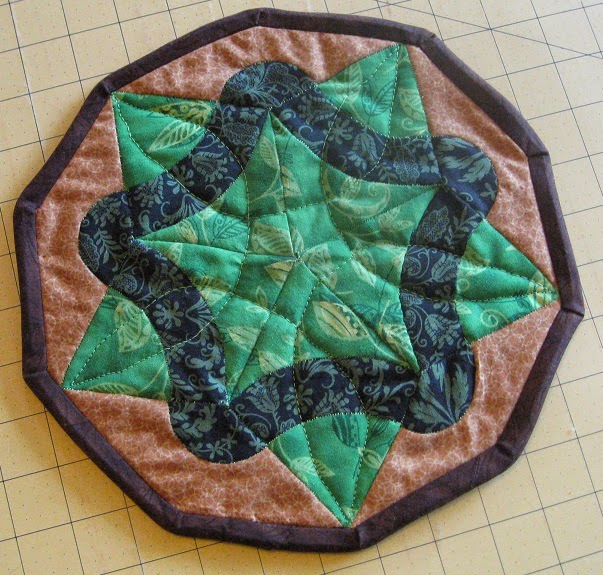
I made this pot holder as a test to see if it was feasible to make the entire full sized quilt this way:


Although this was strictly feasible, I found that all the curved lines and sharp points made this too tricky for my skill level.

So I decided to tweak the matching rules into straight lines:


This way I can machine piece these straight lines first and paper piece the rhombi.


Constructing Penrose Tiling using Inflation/Deflation Properties

One of the mind-bending properties of a Penrose tiling is that if all the rhombi in a given tiling are broken up like so:


The resulting tiling is also a Penrose tiling of smaller tiles.  In this example I deflate this simple tiling one level:


Now I can deflate this tiling down another level (I shaded a couple of rhombi from the previous level to illustrate this):

You can continue this indefinitely.  Here's 3 and 4 level deflation:


The flip side of this is inflation; any tiling can be combined into larger tiles by reversing this process. So any tiling, no matter how large, is only a subset of a single rhombus (mind = blown).

This inspired me to design a quilt that exploits this property.  I first thought it would be interesting to have a quilt that uses different sized rhombi:


Then I thought it would be cool if I designed a quilt where all the rhombi were the same size, but by using different colors and/or values (light and dark), an inflated level of Penrose tiling would emerge:


The combination of this design with the matching rule design above became the final design for the Christmas tree skirt:

Tuesday, December 24, 2013

Christmas Quilts

These are the quilt projects that I made for Christmas Presents this year:


I made this one for Mama.  I had called it a Rhombi-Tri-Hex quilt, but since learned that the pattern has a name; it's called a Ferris Wheel quilt.  I hand pieced it using English Paper piecing.


I made this one for my nephew.  Both of these quilts were the full-sized quilt version of the the pillows I made them two years ago.


I made this bag for my sister-in-law.  It's a log cabin block made with batiks, and I inserted thin black strips to create the stained glass effect.

Friday, September 20, 2013

Just like the Lakers and the Jazz

I started this blog 5 years ago when we bought this house (ours is the one at 6 o'clock):

This photo was taken from the air when our friend Will took us up in a plane last month.

I named this blog after the creek which ran next to it, but then they redirected the creek away from the house.

Now we are moving 2600 miles away, but like the L.A. Lakers and Utah Jazz,  I've decided to keep the blog going from Pittsburgh and to keep its now-no-longer-relevant name.

Henri liked to snuggle with Chris every morning after coffee.  This photo was taken the last morning we had coffee in Dunawi Creek.
I'm going to miss this little home and the years we spent in Corvallis.  But this blog will always be a reminder.

Friday, August 23, 2013

Poppyseed's Kaleidoscope Quilt


This is a quilt I made for a friend who hasn't been born yet. She was supposed to arrive yesterday, but she's running late (so typical of a Virgo).

Friday, May 10, 2013

Crib Quilt Design Ideas

I'm working on new crib quilt for Little Miss B-D (due in August).

I'm ignoring colors for now - this is just pattern playing.

I've wanted to make a quilt on the 54-40 or Fight Block (or variants of that) for it's Oregon Territory history:


 I'm also considering doing a sampler:


Another Foundation Pieced quilt


I considered a Friendship Star for my last crib quilt.  I'm still intrigued by it.


Friday, May 3, 2013

Foundation Pieced Quilt - Piecing Phase

One of the benefits of Foundation Piecing is that you don't have to be very precise about cutting the patches.  I find it helpful if the seam allowance is at least 1/4 inch.  The more you have, the more forgiving the process is.  It's also easier to accurately align your patches if the angles are approximately correct.


First I print out the pattern and make 80+ copies.  Measure to make sure your printer and copier are calibrated enough to print these out as perfect 8 inch by 8 inch squares.

You need 80 blocks for the quilt, but print extras.  I found that when I make errors, it's sometimes impossible to undo the mistake without ripping the paper beyond usability.

I've tried this with the special foundation paper available at fabric stores, as well as standard copy paper.  It didn't notice a significant difference, so I wouldn't endorse the special paper.

Step by step:

1. Crease the paper along the next seam you'll be sewing.

2. Trim to 1/4 inch.

3. Place next patch onto the block right sides together, lining up the just trimmed edge.

4. Carefully move block to machine and sew along seam.  Reduce the stitch length for this; it will make it easier to remove the paper later.

5. Press open.  The moment of truth - hold this up to a light to make sure that the new patch adequately covers the area it needs to.  This is the most common (and frustrating) error.  It's difficult to remove and redo this without tearing the paper beyond usability.  With repetition, you develop a knack for this and this error doesn't occur as often.

Some Tips:

First thing you'll notice is that these steps don't work for the first two patches since there's no base to add the new patch to.  This can be tricky at first, but if you can afford to use generously cut patches, you can minimize the fussiness of attaching these patches.  Everything gets a little easier after these first patches are secured to the paper.


I take one of the spare printed paper foundations and cut out the patches 1, 2, and 6 and use them as templates for cutting patches 1, 2, 3, 6, and 9 (patches 3 and 9 are mirrors of 1 and 6 respectively).


I make sure to give at least 1/2 in seam allowance.

For the corner patch (13), I make half triangles from squares that are at least 4 inches.


For the rest of the patches, I just cut strips that are as wide as the patch's longest side.  Then I sew the strip on the block and cut to spec after it's sewed on.  The leftover strip can be used on the next block.


I like to piece the four blocks of each compass star at a time.


When all the patches are added, trim the block.


Finally, sew the four blocks together to complete the compass star.  Use the 4 corner trick to minimize the bulging in the middle.


I found it helpful to not remove the paper until the entire top is complete.

< Previous Post - Design Phase